
5 MIN READ
How to Research NFL Receiving Yards Props: Targets, Matchups and Game Script

PickFinder Team •Updated: Nov 06, 2026
Receiving yards are one of the most popular NFL player props and one of the noisiest. A receiver can see ten targets and finish with 40 yards, or catch one deep ball and clear his line by halftime. The way through the noise is to research the inputs: how often he gets the ball, what the defense allows to his position, and how the game is likely to unfold. Here is that process for George Kittle's line of 68.5 receiving yards in San Francisco's home game against Las Vegas on Sunday, November 8, 2026.
Read the yards chart, then look closer
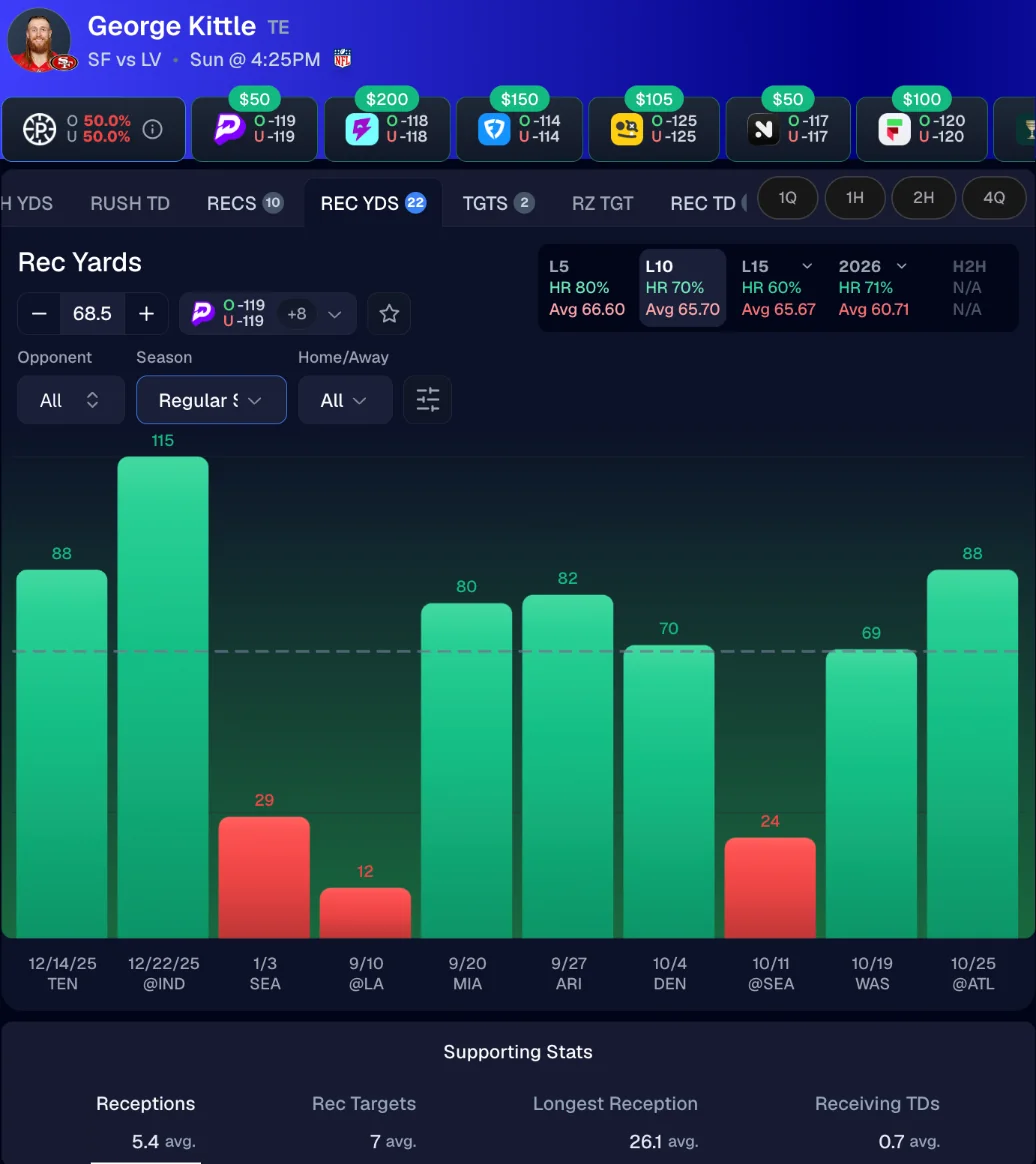
First, set the Season filter to Regular Season. NFL starters barely play in the preseason, and those games otherwise show up as DNP markers or tiny numbers. With the filter on, Kittle went over 68.5 in 7 of his last 10 games and 5 of 7 this season. PrizePicks had moved the line down a yard, from 69.5 on the morning of November 5.
Then look at how he got there. This season he posted 12, 80, 82, 70, 24, 69 and 88. Two of the five overs, 70 against Denver and 69 against Washington, cleared by a yard and a half or less. And the two misses were not close: 12 yards at the Rams on September 10 and 24 at Seattle. That is why his season average (60.7) sits below the line while his hit rate is 71%. When the average and the hit rate disagree, look at the middle game. His median this season is 70, just above the line.
The 10-game window also reaches into last season (December 14 and 22, and January 3). In the NFL, a 10-game window often crosses seasons, so the season column is usually the better read for role and offense.
Targets come first
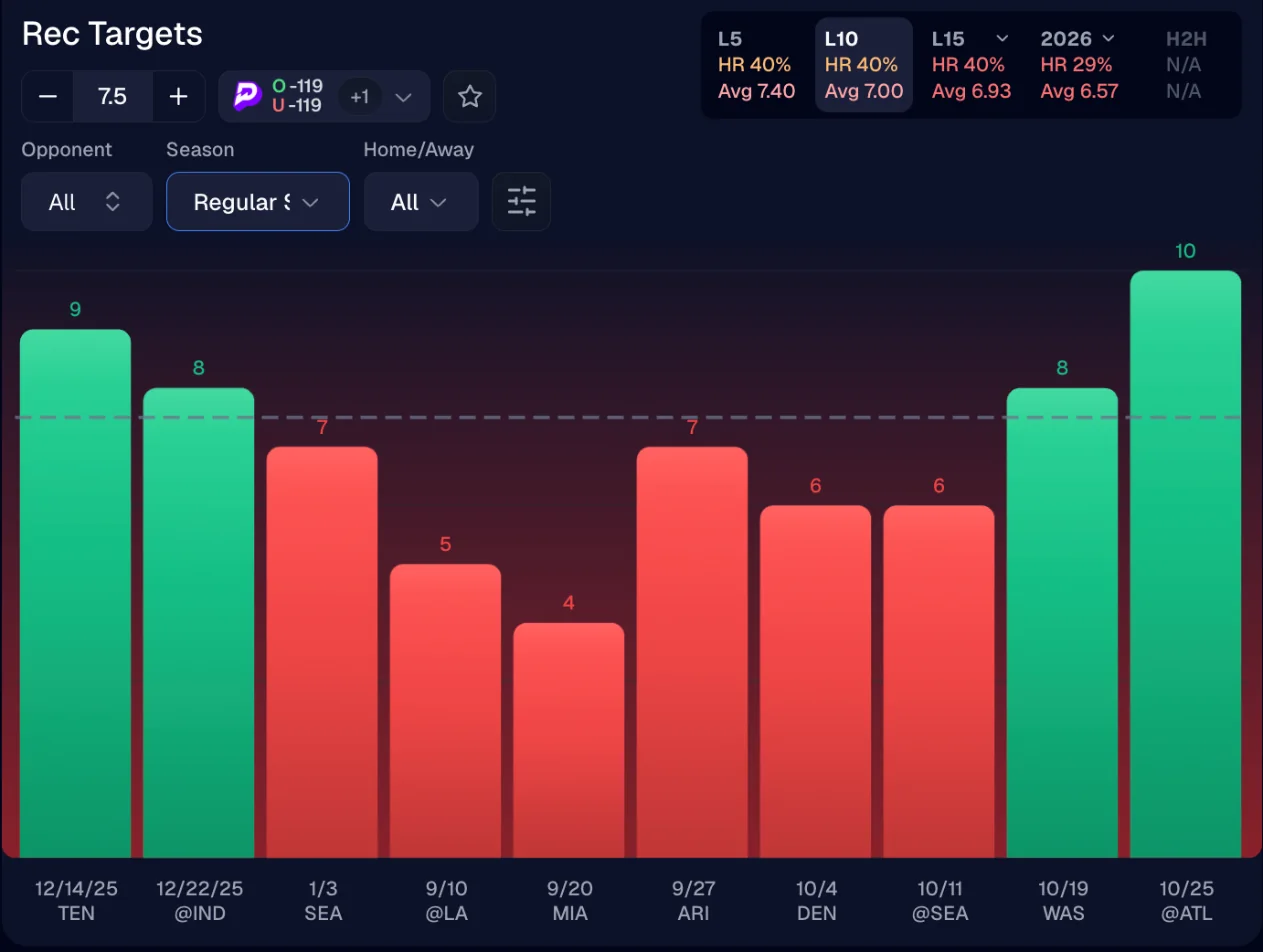
Yards are targets times what he does with them. Kittle had 5, 4, 7, 6, 6, 8 and 10 targets this season, an average of 6.57, and he turned those 46 targets into 425 yards, about 9.2 yards per target. At that rate he needs roughly 7.5 targets to reach 68.5 yards, which happens to be exactly where his targets line sat.
The trend helps the over: his last two games were his two biggest target counts, 8 and 10, and he went over in both. The exception is September 20 against Miami: four targets, 80 yards. One long catch can carry a game, which is why the Longest Reception stat under the chart (26.1 yards a game over his last 10) is worth a look. A player with a big-play habit can beat a line on low volume. A player without one needs targets.
Check the defense against his position
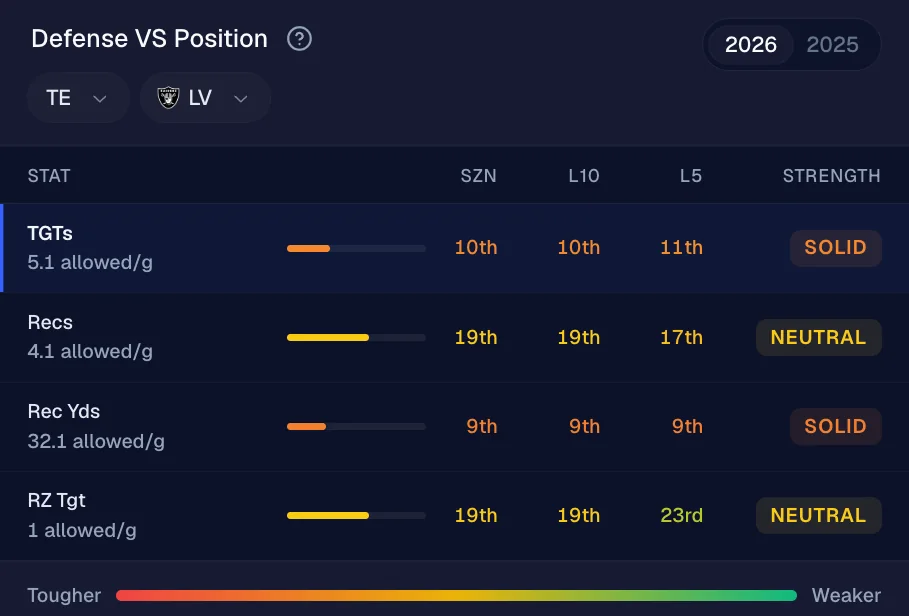
The Defense tab compares the opponent against his position. Las Vegas was a solid matchup for tight ends: 9th in receiving yards allowed (32.1 a game to the position) and 10th in targets (5.1), but 19th in receptions and red zone targets. Its ranks were steady across the season, last 10 and last 5.
Keep the scale in mind. 32.1 yards a game is what all tight ends combined have managed against the Raiders, and Kittle's line is twice that. Elite players beat positional averages all the time, so treat a solid ranking as a reason for caution, not a veto. The free NFL defense vs tight ends page lets you compare every team.
Game script: the spread and total
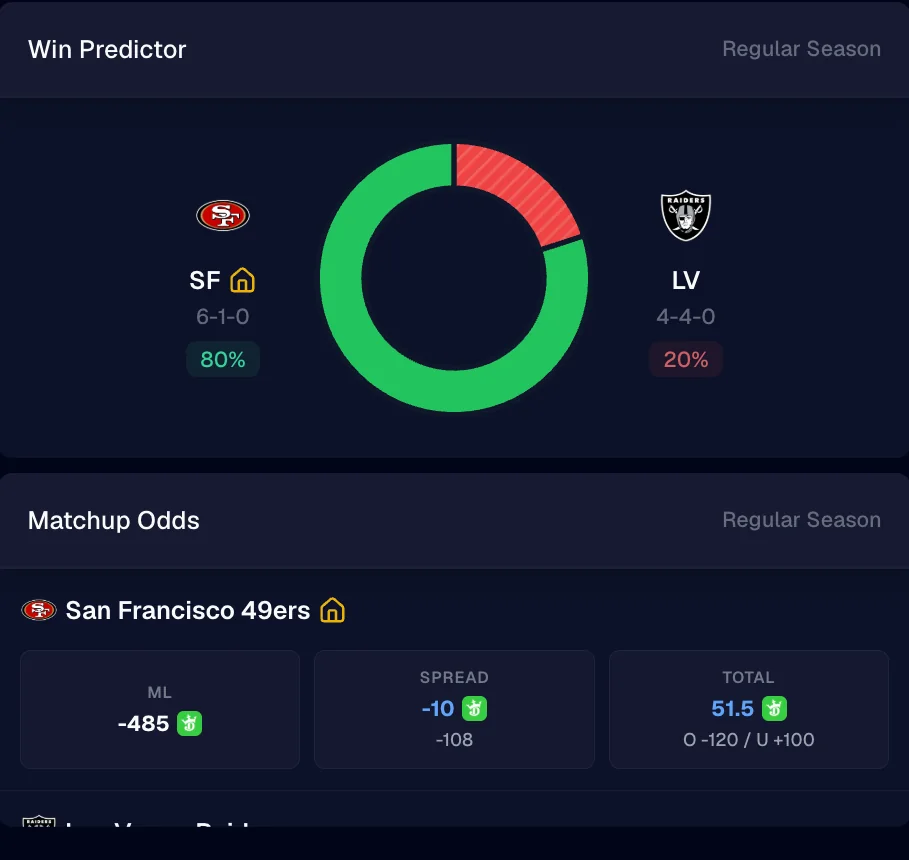
The Odds tab has the win predictor and the game lines. San Francisco was 80% to win, a 10-point favorite (-485 on the moneyline) with a total of 51.5. The spread and total together give a team total: (51.5 + 10) / 2 is about 31 points for the 49ers. That is a lot of offense to go around, and it leans toward the over.
The risk is the second half. A team up by two scores late tends to run the ball and protect the lead, which caps targets for everyone. Big favorites can produce early volume and a quiet fourth quarter. If a receiver's line depends on a full game of targets, a likely blowout is a reason to look at a lower alt line or a receptions line instead.
Compare lines and markets
The row of apps at the top of the player page shows each app's price side by side, and the circle on the left turns the sportsbook prices into an over and under percentage. For Kittle's 68.5 it read 50% and 50%: the books saw it as a coin flip. When apps post different numbers for the same player, the Discrepancies page in PickFinder lists the biggest gaps across the board. The minus and plus buttons by the line step through the alt lines, a quick way to see how the hit rate changes a few yards lower or higher.
Receiving yards checklist
- Turn on the Regular Season filter and read the season column alongside L5 and L10.
- Look at the margins of the overs and misses, not only the count.
- Check targets and yards per target, and the targets trend.
- Check the defense against his position, and remember it averages the whole position.
- Use the spread and total to estimate the team total and blowout risk.
Quarterbacks follow the same logic with pass attempts; see how to research passing yards props. Outdoors in November, also check how weather affects NFL props. The full workflow is in how to research NFL player props.


