
5 MIN READ
NBA Defense vs Position for Player Props: How to Read It

PickFinder Team •Updated: Nov 06, 2026
Through eight games of the 2026-27 season, New Orleans had allowed 21.4 points a game to opposing point guards, the most in the NBA. On Friday, November 6, LaMelo Ball and Minnesota visited New Orleans with Ball's points line at 21.5 on PrizePicks. The matchup said over. His own season said under: he had cleared 21.5 in 2 of 9 games. This guide shows how to read defense vs position, and how to settle it when the matchup and the player disagree.
What defense vs position measures
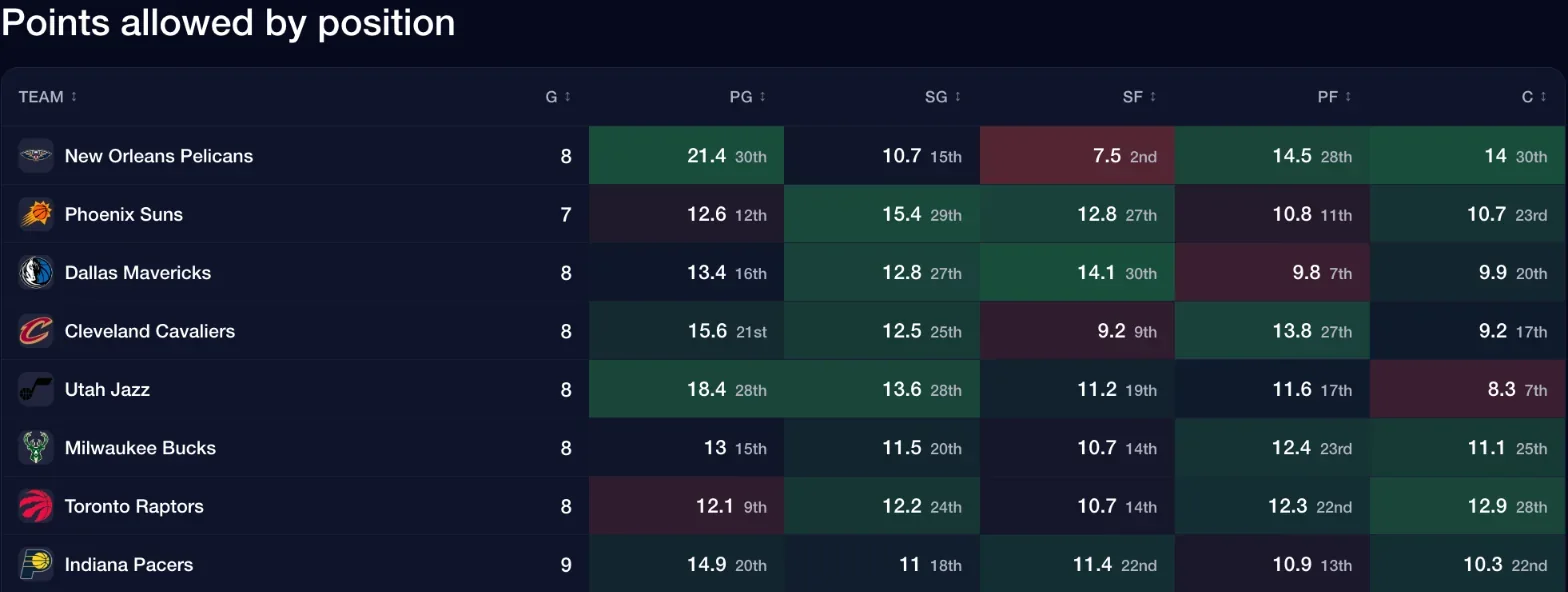
Defense vs position (DvP) takes everything a team has allowed to players at each position and averages it per game, then ranks the 30 teams. Rank 1 allows the least, rank 30 the most. The free NBA defense vs position page shows points allowed to every position for every team, and you can open a single position, such as point guards.
Look across New Orleans' row and the weak spots are specific. The Pelicans ranked 30th against point guards (21.4) and centers (14.0) and 28th against power forwards (14.5), but 2nd against small forwards (7.5). "Bad defense" is not one number. A wing facing New Orleans had one of the hardest matchups in the league that week, while a point guard had the easiest.
The Defense tab on a player page
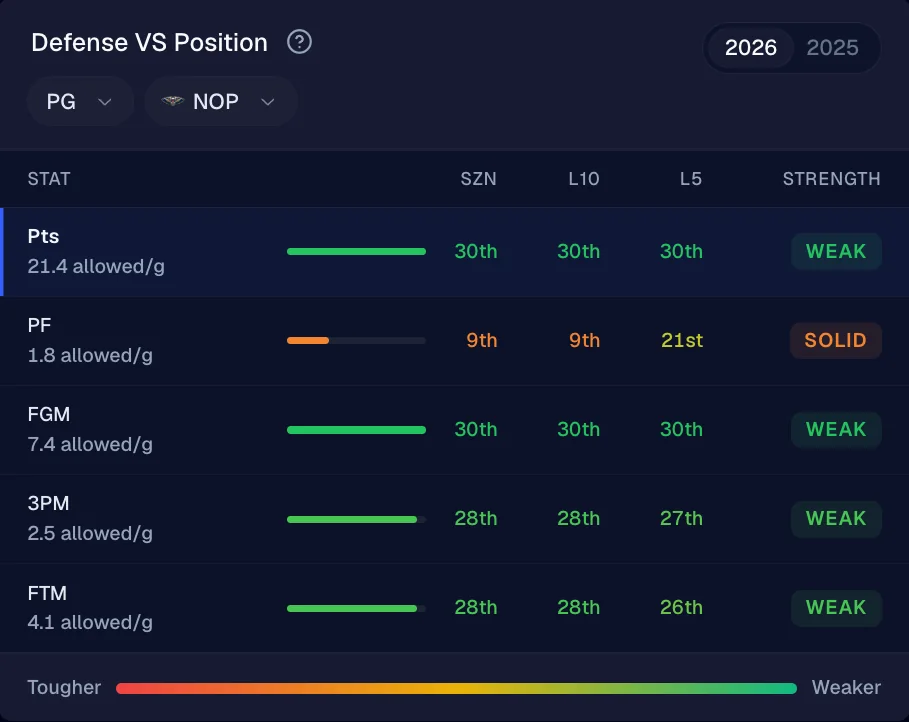
On a player's page, the Defense tab shows the opponent against his position for each stat, with ranks for the season, the last 10 games and the last 5, and a strength label such as Solid, Neutral or Weak. For Ball, New Orleans ranked 30th in points, 30th in field goals made (7.4 a game), 28th in threes (2.5) and 28th in free throws made (4.1). The bar and color move from red (tough) to green (weak), so you can scan a column at a glance.
Early in the season the three windows overlap. New Orleans had only played eight games, so its last 10 and its season were the same games, and the last 5 was most of them. By December the columns separate, and a team that is 30th on the season but 12th over its last five is telling you its defense has changed, often because of a lineup change or a returning player.
The matchup is only half the read
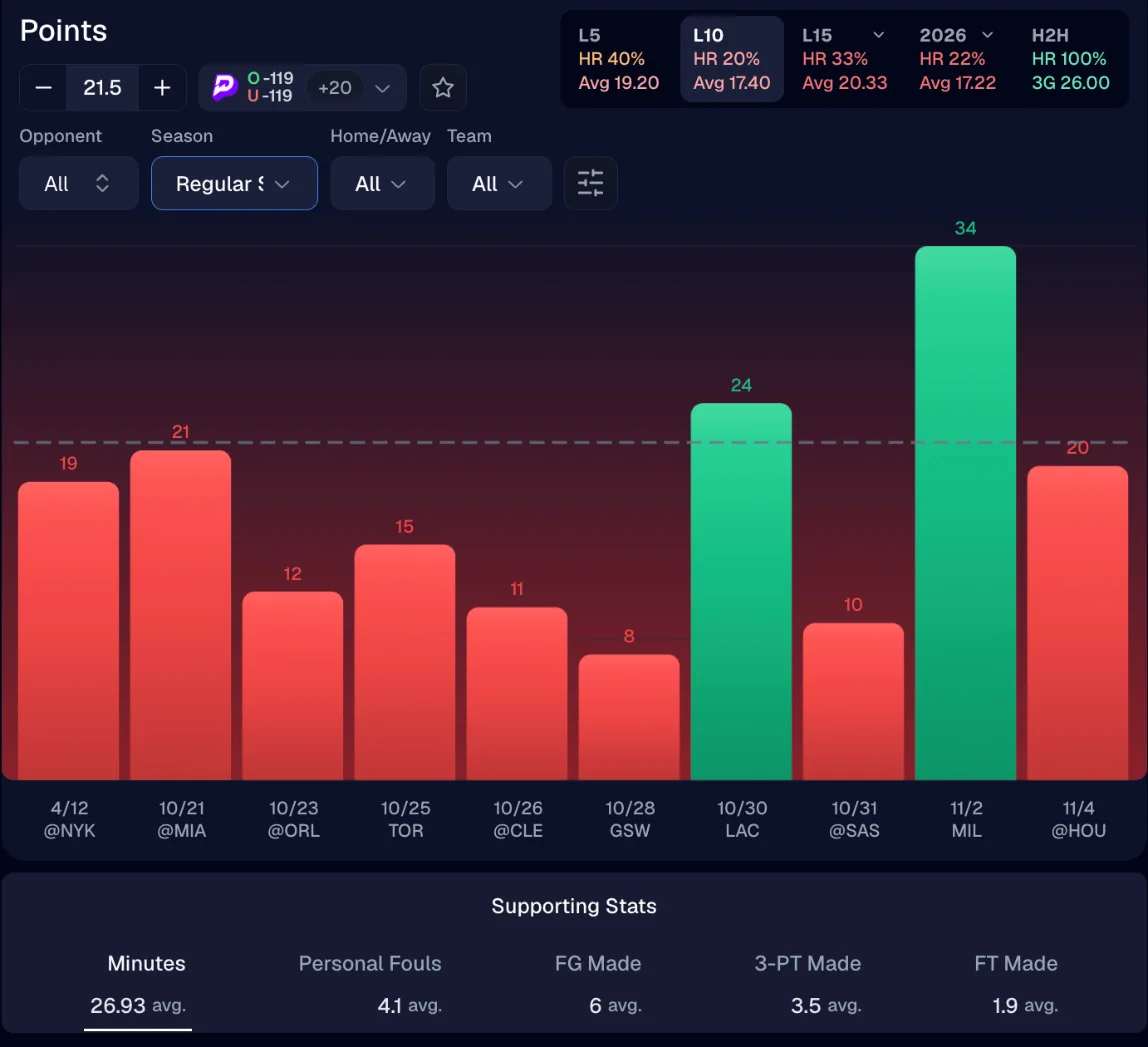
Now the other half. With the Regular Season filter on, Ball scored 21, 12, 15, 11, 8, 24, 10, 34 and 20 in his first nine games, an average of 17.22, with two overs (24 against the Clippers and 34 against Milwaukee). The last bar shows 20 at Houston, just under. His three earlier games against New Orleans in the head-to-head column averaged 26 points, but three games is too few to lean on.
A 30th-ranked defense raises a player's ceiling. It doesn't change his role. To score 22, a guard needs the minutes and the shots, so the next tab to open is minutes.
Minutes decide whether the matchup matters
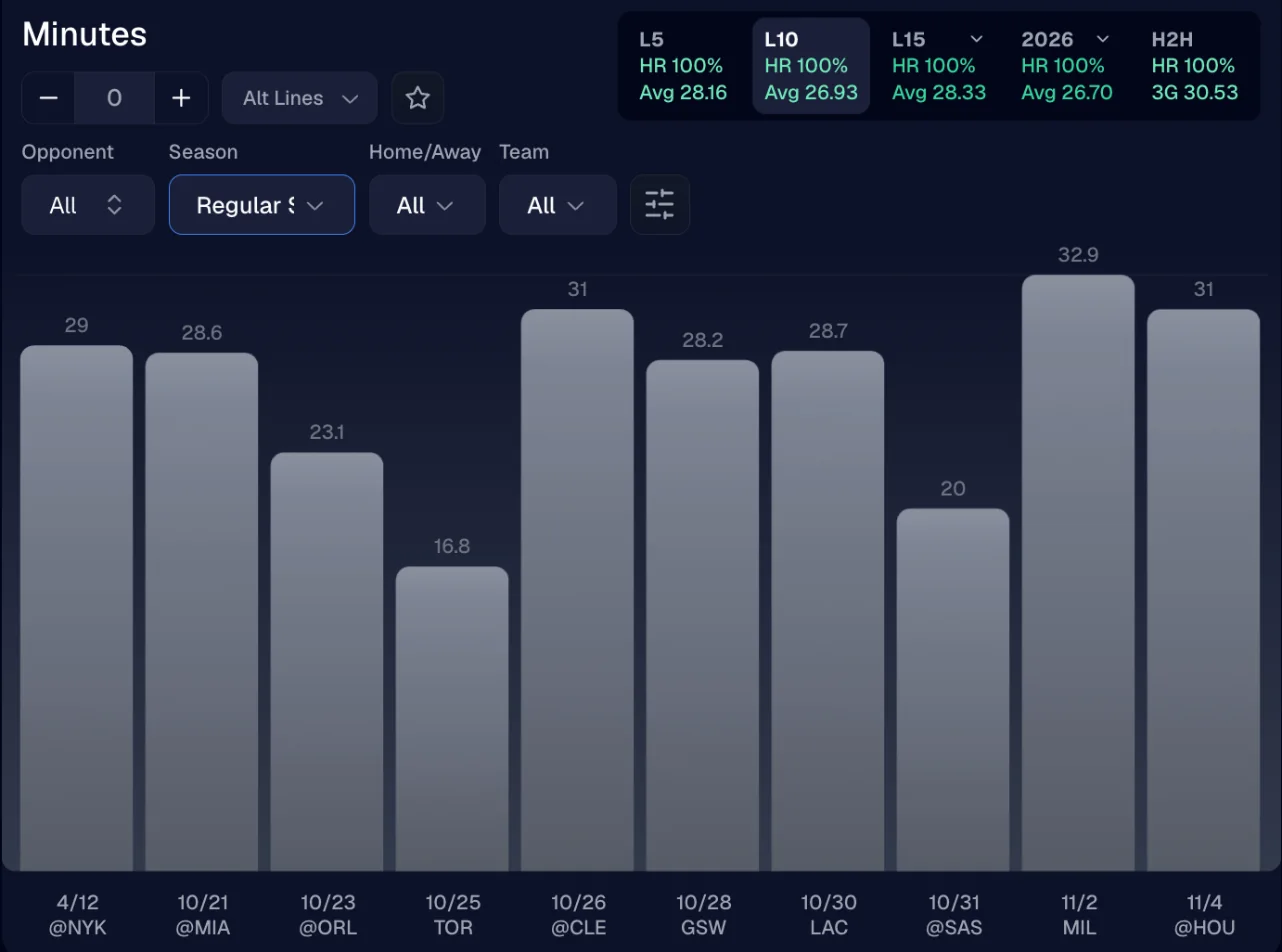
Ball averaged 26.7 minutes this season, with games of 23.1, 16.8 and 20 mixed in. That explains most of the 17-point average. His last five games averaged 28.2 minutes, and the last two were 32.9 and 31, when he scored 34 and 20. If those minutes hold, the line is close to his recent level and the matchup can push him over it. If he drops back to 23 to 25 minutes, even the softest defense won't get him there often.
This is the general rule: DvP is most useful for players whose role is stable. For players whose minutes swing, read the minutes chart first and the matchup second.
Things that make DvP misleading
- Small samples. In the first month, eight games against a few high-scoring guards can put a team near the bottom. Check the games count next to each team.
- Position labels. A player is measured against the position he is listed at. Combo guards and big wings can play a different role than their label, so read the opponent's numbers at the neighboring position too.
- The defense's own injuries. A team that was missing its best perimeter defender for a week will look worse than it is once he returns. The Injuries tab shows both teams.
- Pace and totals. A high game total means more possessions for everyone. The Odds tab had Minnesota favored by 3.5 with a total of 230.5.
A defense vs position checklist
- Find the opponent's rank against the player's position for the exact stat, not only points.
- Compare season, last 10 and last 5 to see if the defense is changing.
- Check the player's own chart with the Regular Season filter.
- Confirm his minutes support the line before trusting the matchup.
- Look at the defense's injuries and the game total.
To find the softest matchups across the league in one place, use the free NBA soft spots page or the team rankings. For reading the hit rate columns themselves, see NBA hit rates explained.


